Presentation of selected publications
B. Sadoughi, R. M. Petersen, S. K. Patterson, E. Slikas, C. Adjangba, N. Ryan, C. E. Costa, L. E. Newman, M. M. Watowich, C. R. Kelsey, A. Greenier, E. A. Goldman, J. E. Negrón-Del Valle, D. Phillips, I. Thompson, S. E. Bauman Surratt, O. González, N. Compo, A. Burgos, Cayo Biobank Research Unit, A. R. DeCasien, K. L. Chiou, C. S. Walker, A. V. Ruiz Lambides, M. I. Martínez, K. N. Sterner, A. D. Melin, L. J. N. Brent, J. P. Higham, M. J. Montague, M. L. Platt, N. Snyder-Mackler, A. J. Lea, Age and early life adversity shape heterogeneity of the epigenome across tissues in macaques. Science 392, eaea4922 (2026).
B. Sadoughi, R. Hernández-Rojas, H. Hamou, R. Lopez, M. Mah, E. Slikas, S. M. V. Simmons, J. D. Orkin, J. P. Higham, S. F. Brosnan, K. M. Jack, F. A. Campos, N. Snyder-Mackler, A. D. Melin, Non-Invasive Measures of DNA Methylation Capture Molecular Aging in Wild Capuchin Monkeys. Molecular Ecology 35, e70468 (2026).
A. Longtin, M. M. Watowich, B. Sadoughi, R. M. Petersen, S. F. Brosnan, K. Buetow, Q. Cai, C. B. R. Unit, M. D. Gurven, J. P. Higham, H. M. Highland, Y.-T. Huang, H. Kaplan, T. S. Kraft, Y. A. L. Lim, J. Long, A. D. Melin, M. J. Montague, J. Roberson, K.-S. Ng, M. L. Platt, I. A. Schneider-Crease, J. Stieglitz, B. C. Trumble, V. V. Venkataraman, I. J. Wallace, J. Wu, N. Snyder-Mackler, A. Jones, A. G. Bick, A. J. Lea, Cost-effective solutions for high-throughput enzymatic DNA methylation sequencing. PLOS Genet. 21, e1011667 (2025).
In brief: DNA methylation is a key chemical signal that helps control how genes work. It plays an important role in aging, evolution, and disease. But studying it is hard—current methods are expensive, can damage DNA, or only look at a small part of the genome. To solve this, we improved a method called Targeted Methylation Sequencing (TMS), which can study about 4 million DNA sites at once. We made it smaller, cheaper, and easier to use across different species. We tested it in humans and several types of primates, including monkeys. The result? A fast, affordable, and reliable way to study DNA methylation across many species—making it easier and cheaper than ever before. This opens new doors for research in aging, evolution, and medicine.
D. De Moor, M. Skelton, MacaqueNet, F. Amici, M. E. Arlet, K. N. Balasubramaniam, S. Ballesta, A. Berghänel, C. M. Berman, S. K. Bernstein, D. Bhattacharjee, E. Bliss-Moreau, F. Brotcorne, M. Butovskaya, L. A. D. Campbell, M. Carosi, M. Chatterjee, M. A. Cooper, V. B. Cowl, C. De la O, A. De Marco, A. M. Dettmer, A. K. Dhawale, J. J. Erinjery, C. L. Evans, J. Fischer, I. García-Nisa, G. Giraud, R. Hammer, M. F. Hansen, A. Holzner, S. Kaburu, M. Konečná, H. N. Kumara, M. Larrivaz, J.-B. Leca, M. Legrand, J. Lehmann, J.-H. Li, A.-S. Lezé, A. MacIntosh, B. Majolo, L. Maréchal, P. R. Marty, J. J. M. Massen, R. I. Maulany, B. McCowan, R. McFarland, P. Merieau, H. Meunier, J. Micheletta, P. S. Mishra, S. A. M. Sah, S. Molesti, K. S. Morrow, N. Müller-Klein, P. O. Ngakan, E. Palagi, O. Petit, L. S. Pflüger, E. P. di Sorrentino, R. Raghaven, G. Raimbault, S. Ram, U. H. Reichard, E. P. Riley, A. V. Rincon, N. Ruppert, B. Sadoughi, K. Santhosh, G. Schino, L. K. Sheeran, J. B. Silk, M. Singh, A. Sinha, S. Sosa, M. S. Stribos, C. Sueur, B. Tiddi, P. J. Tkaczynski, F. Trebouet, A. Widdig, J. Whitehouse, L. J. Wooddell, D.-P. Xia, L. von Fersen, C. Young, O. Schülke, J. Ostner, C. Neumann, J. Duboscq, L. J. N. Brent, MacaqueNet: Advancing comparative behavioural research through large-scale collaboration. J. Anim. Ecol. 94, 519–534 (2025).
In brief: Scientists are collecting more data on animal behavior than ever before. But because the data is collected in different ways, it’s hard to compare across studies—slowing down big-picture research. To solve this, the lead and senior authors created MacaqueNet, a new database that brings together standardized social behavior data from 14 macaque species. This is a team effort involving over 100 researchers who share their data and work together to set common standards. MacaqueNet helps scientists compare behaviors across species more easily and encourages a culture of sharing and collaboration in the research community.
B. Sadoughi, R. Mundry, O. Schülke, J. Ostner, Social network shrinking is explained by active and passive effects but not increasing selectivity with age in wild macaques. Proc. R. Soc. B Biol. Sci. 291, 20232736 (2024).
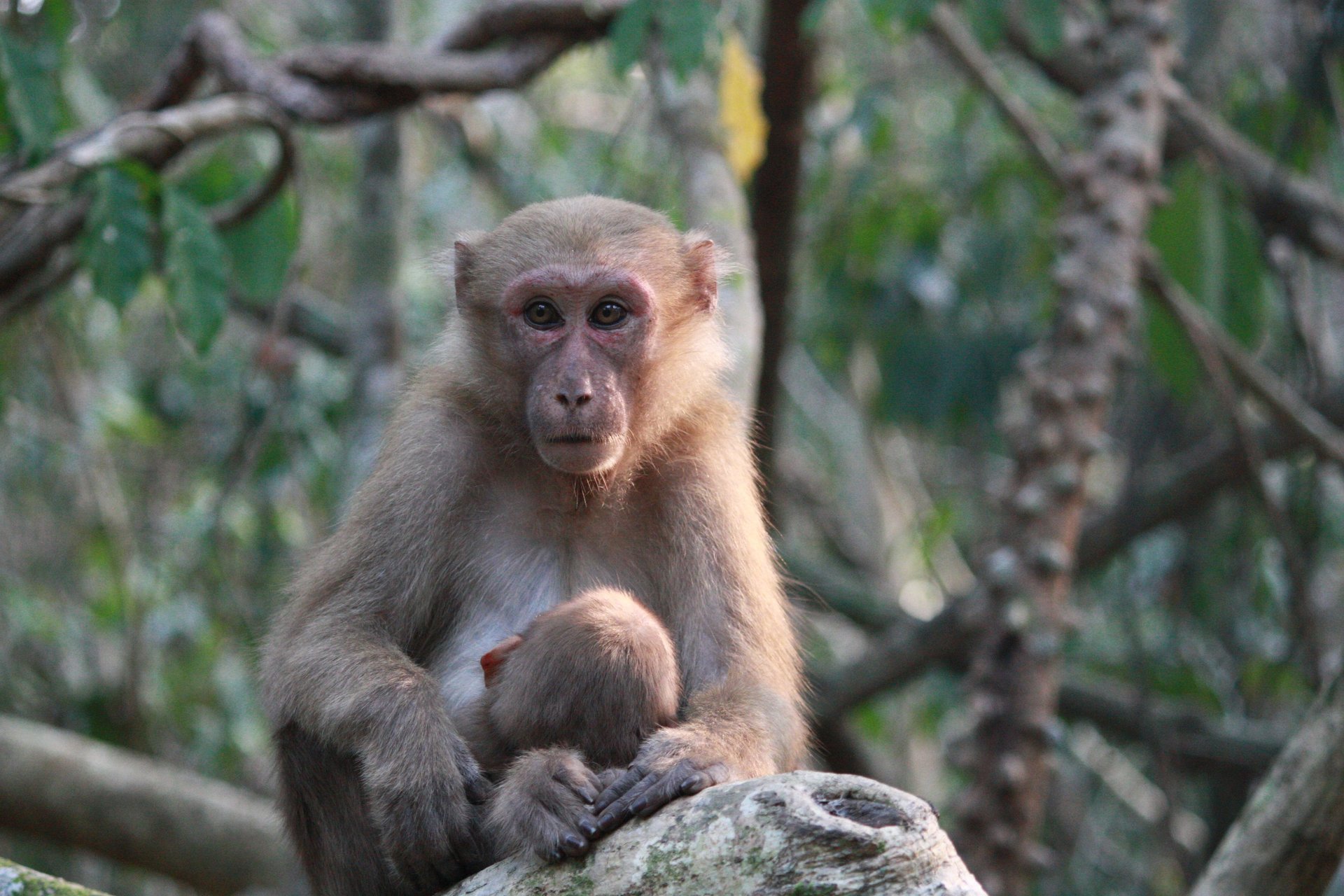
In brief: As people age, they often reduce their social interactions and narrow their social circles—a pattern known as "social aging." While this is sometimes attributed to physical decline or social exclusion, research supports an alternative explanation: older adults tend to become more selective, prioritizing close, meaningful relationships over a broad network. This is the social selectivity hypothesis—a shift from quantity to quality in social life. To explore whether similar patterns occur in other species, we studied female Assamese macaques in their natural forest habitat in Thailand, observing them for over 13,000 hours across many years. We found that older females interacted with fewer individuals and engaged in fewer social behaviors. However, this decline was not due to increased isolation—rather, they became less socially active overall. Importantly, older monkeys still preferred their close companions, indicating they remained socially selective. Yet, this selectivity did not increase with age. This suggests that social disengagement and social selectivity may follow distinct trajectories during aging. While humans often maintain close bonds while reducing their social circle, the macaques in our study showed a general decline in social involvement without greater selectivity. This challenges the idea that social aging is always a deliberate, quality-driven process—and suggests that in some species, it may be driven more by physical or energetic constraints than by a conscious shift in social priorities.
B. Sadoughi, D. Schneider, R. Daniel, O. Schülke, J. Ostner, Aging gut microbiota of wild macaques are equally diverse, less stable, but progressively personalized. Microbiome 10, 95 (2022).
In brief: In humans, the gut microbiota changes with age, but these shifts are often linked to modern lifestyles, medical interventions, and health conditions—making it hard to separate aging from environmental influences. Most studies are conducted in controlled or clinical settings, which limits our understanding of how aging naturally shapes the gut microbiome. To address this, we studied wild female Assamese macaques in their natural forest habitat, using repeated sampling over three seasons to track age-related changes in gut bacteria. We found that while microbial diversity remained stable across adulthood, the gut communities became less stable and more unique to each individual—meaning older macaques developed increasingly personalized microbiomes. This personalization was not due to changes in core bacterial groups, but to a rise in rare, less common taxa associated with a more unstable community composition. Reduced social contact may contribute to this trend, but cannot fully explain it. These findings suggest that microbial aging is not just a product of modern life, but may be an evolved trait shaped by natural selection. By studying wild primates, we gain insights into the natural trajectory of gut microbiota aging—free from the confounding effects of medicine, diet, and lifestyle.
O. Schülke, S. Anzà, C. Crockford, D. De Moor, T. Deschner, C. Fichtel, J. F. Gogarten, P. M. Kappeler, V. Manin, N. Müller-Klein, L. Prox, B. Sadoughi, S. Touitou, R. M. Wittig, J. Ostner, Quantifying within-group variation in sociality—covariation among metrics and patterns across primate groups and species. Behav. Ecol. Sociobiol. 76, 50 (2022).
B. Sadoughi, S. Anzà, C. Defolie, V. Manin, N. Müller-Klein, T. Murillo, M. Ulrich, D. Wu, “Parasites in a social world: Lessons from primates” in Animal Behavior and Parasitism, V. Ezenwa, S. M. Altizer, R. Hall, Eds. (Oxford University Press, 2022; https://doi.org/10.1093/oso/9780192895561.003.0003), p. 0.
S. Ballesta, B. Sadoughi, F. Miss, J. Whitehouse, G. Aguenounon, H. Meunier, Assessing the reliability of an automated method for measuring dominance hierarchy in non-human primates. Primates, doi: 10.1007/s10329-021-00909-7 (2021).
B. Sadoughi, C. Girard-Buttoz, A. Engelhardt, M. Heistermann, J. Ostner, Non-invasive assessment of metabolic responses to food restriction using urinary triiodothyronine and cortisol measurement in macaques. Gen. Comp. Endocrinol. 306, 113736 (2021).
B. Sadoughi, L. Lacroix, C. Berbesque, H. Meunier, J. Lehmann, Effects of social tolerance on stress: hair cortisol concentrations in the tolerant Tonkean macaques (Macaca tonkeana) and the despotic long-tailed macaques (Macaca fascicularis). Stress 24, 1033–1041 (2021).